
Case StudyNo. 003
Parenting the Spectrum
Found, priced right, and free of per-seat software fees. We built all three.
A Northwest Florida autism-family practice needed three things at once: to be found by the families searching for help, to be priced and structured like a real business, and to run without paying per-seat software fees for every tutor. We built the website, the business model, and the custom app as one system.
The short version
Merrie Weekley is an ESE teacher and autism mom who sits in a gap no competitor can honestly claim: real academics taught with behavioral technique. Her practice had no web presence, no clear pricing, and tutoring software that charged more for every tutor. We built all three fixes at once: a site that reads as the local authority, a business model she maintains herself, and custom software the practice owns outright.
- A site built to be cited by Google and AI
- Positioned as a category of one
- A real business model she updates herself
- Custom software the practice owns outright
- Flat cost as she adds tutors, not per seat
- Built to license to other practices later
The full story, and how the three fit together, is below.
Snapshot
- Client
- Parenting the Spectrum, LLCMilton, FL
- Founder
- Merrie WeekleyFormer Florida ESE teacher, autism mom
- Sector
- Autism & special-needs family support
- Scope
- Marketing website, business model, custom software
- The work
- Brand, site, local SEO, custom tutoring platform
- Live at
- spectrumparenting.org
The client
Merrie Weekley spent years as a Florida special-education teacher before going all in on her own practice. She serves autism and special-needs families two ways: IEP advocacy, and skill-targeted tutoring for kids who are often left behind by standard academic instruction.
Her wedge is specific. ABA therapy works on behavior. School is supposed to handle academics, but classroom teachers rarely have behavioral training. That leaves a hole: actual reading, writing, and math taught with behavioral technique. Merrie sits in that exact gap, because she is an ESE teacher, an autism parent, and trained in behavioral method.
No competitor can honestly claim the same spot.
The problem was that none of it was set up to grow. There was no real web presence, no clear pricing or entity structure, and the tutoring side ran on off-the-shelf software that charged more for every tutor she added.
The website
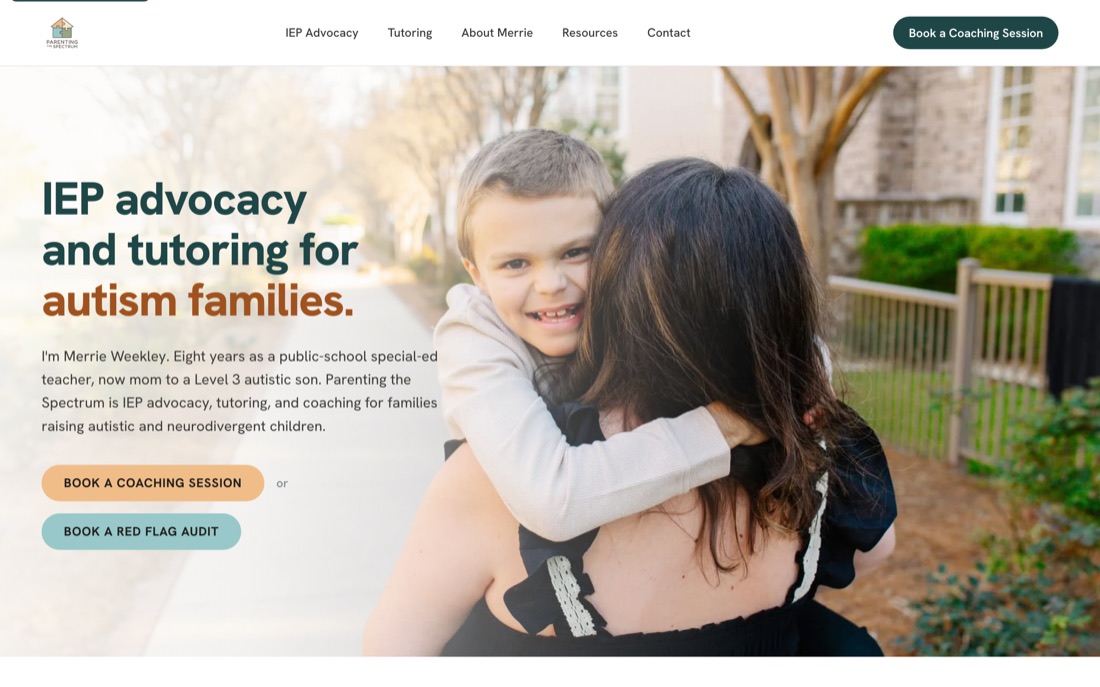
We built spectrumparenting.org as a fast static site with one job: make Merrie findable by the families already searching for help, and answer their questions before anyone else does.
What we did
- Positioned tutoring as a category of one, "the missing piece between ABA and academics," so the site competes on an uncontested term instead of fighting national keywords it could never win.
- Wrote and structured a library of family-facing articles across IEP advocacy, newly diagnosed guidance, and Florida-specific resources, each one drafted from Merrie's own recorded teaching so the voice stays hers.
- Engineered the site for AI answer engines as well as Google: full schema markup, an llms.txt index, and clean semantic structure so tools like ChatGPT and Google's AI answers can cite her.
- Wired three booking flows (Red Flag Audit, coaching, tutoring intake) to analytics so every inquiry is tracked to its source.
The resultA site that scores in the low 90s on quality and reads as the local authority, built to be quoted by search engines and AI alike.
The business model
A good website sells nothing if the offer underneath it is unclear. Before scaling anything, we built the practice into a real business.
What we did
- Structured the two services into one story: IEP advocacy gets the right plan on paper, tutoring delivers the instruction that plan promises. Each side feeds the other.
- Set a clean service ladder with a required entry point: a paid audit that qualifies every advocacy engagement, plus straightforward per-hour and per-session pricing so families know the cost up front.
- Built a full financial operating model in a spreadsheet the founder actually maintains: monthly actuals blended with a forecast, an honest breakeven line, tax and savings reserves, and a scenario table. We led with the conservative number, not the hopeful one, so decisions are made on the real floor.
- Mapped the entity and tax setup (LLC formation, owner pay, contractor payments, quarterly estimates) so the business runs clean instead of commingled.
The resultA practice that knows exactly what it charges, what it costs to deliver, and what it takes to break even, with a model the owner can update herself each month.
The custom app
The tutoring side was paying a monthly subscription that scaled with every tutor. We replaced it with software the practice owns: a single application with three role-based views, a full admin console for Merrie, a tutor view, and a parent portal per family.
What it does
- Master calendarAcross every student and assigned tutor, with recurring sessions and reschedule handling.
- Semester goal cycle and progress reportsBuilt for kids who do not test well: individualized goals set at the start, tracked through the term, and an end-of-semester report card that says whether each goal was met, and if not, why, plus a rewrite for next time.
- Scholarship billingBuilt around Florida's Step Up For Students funding, tracked from submitted through reimbursed.
- Parent-facing progress updatesTutors write and send them, with in-app messaging and web-push notifications.
- Guided intake and onboardingPulls each family's paperwork into the app and tags it for tutor matching by subject, schedule, and location.
The app runs as an installable web app first, ready to wrap as a native iOS and Android build from the same code. Every record carries an organization ID, so it was built from day one to be licensed to other practices later.
The resultThe practice owns its software, its cost is flat as it adds tutors instead of rising per seat, and it now holds an asset it can resell.
The throughline
The reason to have one studio build all three is that they are one system. The website captures a lead and hands it to the app's intake. The business model prices what the app tracks and bills. The app delivers the instruction the website promised. Site, strategy, and software move together instead of fighting each other.
Not a page, a plan, and a tool bought from three vendors, but one coherent operation built to grow.
That is the Visible Local difference.
Have a dream that needs more than a website?